6 Critical Insights on IBM Vault’s Unified Public CA Orchestration
For modern enterprises, security is only as strong as its weakest link—often the manual, fragmented management of X.509 certificates. While HashiCorp Vault (now IBM Vault) has been the gold standard for automating internal private key infrastructure (PKI), a critical gap remained: public trust. IBM Vault Enterprise’s latest expansion bridges that gap by integrating public certificate authorities (CAs) directly into a single automated workflow. This article unpacks six key things you need to know about this game-changing capability.
1. The Fragmented Certificate Nightmare
Many organizations have successfully automated internal certificate lifecycle management using Vault’s private PKI. But the moment a service needs a certificate trusted by external browsers or public networks, automation screeches to a halt. Teams must jump out of their pipelines to manually request, renew, and revoke certificates through external CA portals. This dual-track approach—private certs in Vault, public certs elsewhere—creates an operational overhead that invites human error and missed renewals. Without a unified view, security teams lose visibility into expiration dates across different providers, making compliance audits a nightmare. The result is a fragmented system that undermines the very efficiency Vault was designed to deliver.
2. The Outage Clock Is Always Ticking
Every manual certificate becomes a ticking time bomb. When certificate management is split between tools, there’s no central dashboard to monitor expiration dates. Public-facing services like customer websites or APIs can go dark without warning when a certificate expires unexpectedly. This “outage clock” syndrome not only damages user trust but also forces IT teams into firefighting mode instead of focusing on innovation. With IBM Vault’s new public CA orchestration, you gain a single pane of glass that tracks all certificates—private and public—in real time. Proactive alerts and automated renewals replace the stress of manual tracking, significantly reducing the risk of costly downtime.
3. Siloed Governance Breaks Compliance
When governance is split between private and public certificate tools, enforcing unified security policies becomes nearly impossible. Compliance standards like NIST, PCI DSS, or SOC2 require a complete audit trail for every certificate’s lifecycle. Fragmented management forces auditors to cross-reference multiple systems, increasing the chance of gaps or inconsistencies. IBM Vault’s centralized platform eliminates this silo by providing a single source of truth for all certificate policies and audit logs. Every request, renewal, and revocation—whether internal or public—is logged consistently. This unified approach not only simplifies compliance but also strengthens your overall security posture by ensuring no certificate falls through the cracks.
4. Private PKI Won’t Solve Public Trust
Private CAs are excellent for internal trust—microservices, VPNs, or internal apps. But they are useless for customer-facing services that browsers and devices must trust. Relying solely on private PKI limits Vault’s utility in hybrid and multicloud scenarios where external trust is a hard requirement. For instance, a microservice that exposes a public API endpoint cannot use an internal CA certificate because browsers will reject it. The only way to gain public trust is through a publicly trusted CA. IBM Vault’s new integration bridges this gap, allowing your teams to request publicly trusted certificates using the same Vault APIs and workflows they already use for private ones—no need to switch contexts or learn new tools.
5. Unified Public CA Orchestration: The Game Changer
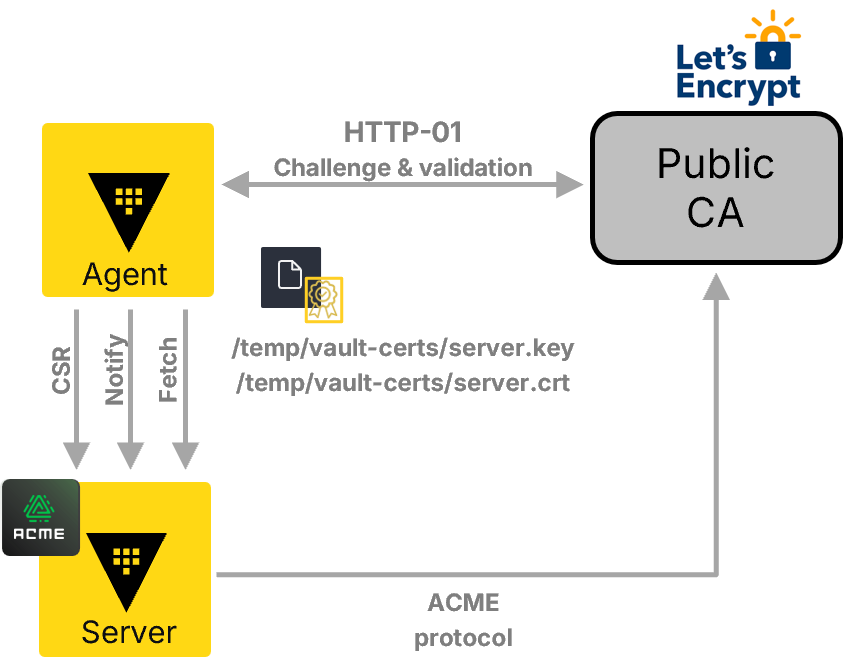
IBM Vault Enterprise now acts as a central proxy, securely managing upstream CA credentials and orchestrating the complex validation challenges required for public certificate issuance. This feature lets development teams request publicly trusted certificates directly from Vault using familiar APIs. The result is a single automated workflow for every certificate your organization needs—whether it’s for an internal microservice or a customer-facing website. Gone are the days of manual CA portals and fragmented management. Instead, you get a unified “single pane of glass” view of your entire certificate footprint, from issuance to expiration. This not only reduces operational overhead but also eliminates the outage clock and governance silos.
6. How It Works: ACME Integration for Seamless Automation
The new public CA orchestration leverages the ACME (Automated Certificate Management Environment) protocol, the industry standard for automating certificate lifecycle with public CAs. Vault acts as an ACME client or proxy, seamlessly managing the validation challenges required by public CAs (like Let’s Encrypt or commercial providers). Your applications can continue to use Vault’s existing secret engine for PKI, now extended to support public trust. This means no changes to your application code—just configure your CA endpoint in Vault and let automation handle the rest. The system supports automated renewal before expiration, revocation management, and full audit logging. Internal anchor links within Vault’s policies can enforce governance rules across both private and public certificates, ensuring consistency.
In summary, IBM Vault’s unified public CA orchestration eliminates the trust gap that has plagued enterprises for years. By consolidating private and public certificate management into a single, automated platform, organizations can reduce complexity, prevent downtime, and maintain compliance with ease. Whether you’re a security architect, DevOps lead, or compliance officer, this capability transforms how you think about certificate lifecycle management. Ready to close the gap? Explore IBM Vault Enterprise today.
Related Articles
- FBI Alert: Cybercriminal Gangs Targeting Logistics Firms in Wave of Cargo Theft Hacks
- Weekly Cyber Threat Roundup: May 4th Edition
- 10 Critical Insights from GitHub's Swift Response to a Remote Code Execution Vulnerability
- The AI Arms Race: 6 Key Threats from Adversaries Using Artificial Intelligence
- Critical Active Exploit in cPanel, Medtronic Data Breach Headline This Week’s Cyber Threats
- A 3D-Printed Pinhole Camera That Creates Stunning Wigglegrams
- Understanding the Four OpenClaw Vulnerabilities: A Technical Walkthrough of the Claw Chain Attack Path
- Securing Your Linux Kernel: A Step-by-Step Guide to Defending Against the Copy Fail LPE Threat