How Astronomers Use Lasers to Sharpen Their View of the Cosmos: A Guide to Adaptive Optics and Interferometry
Overview
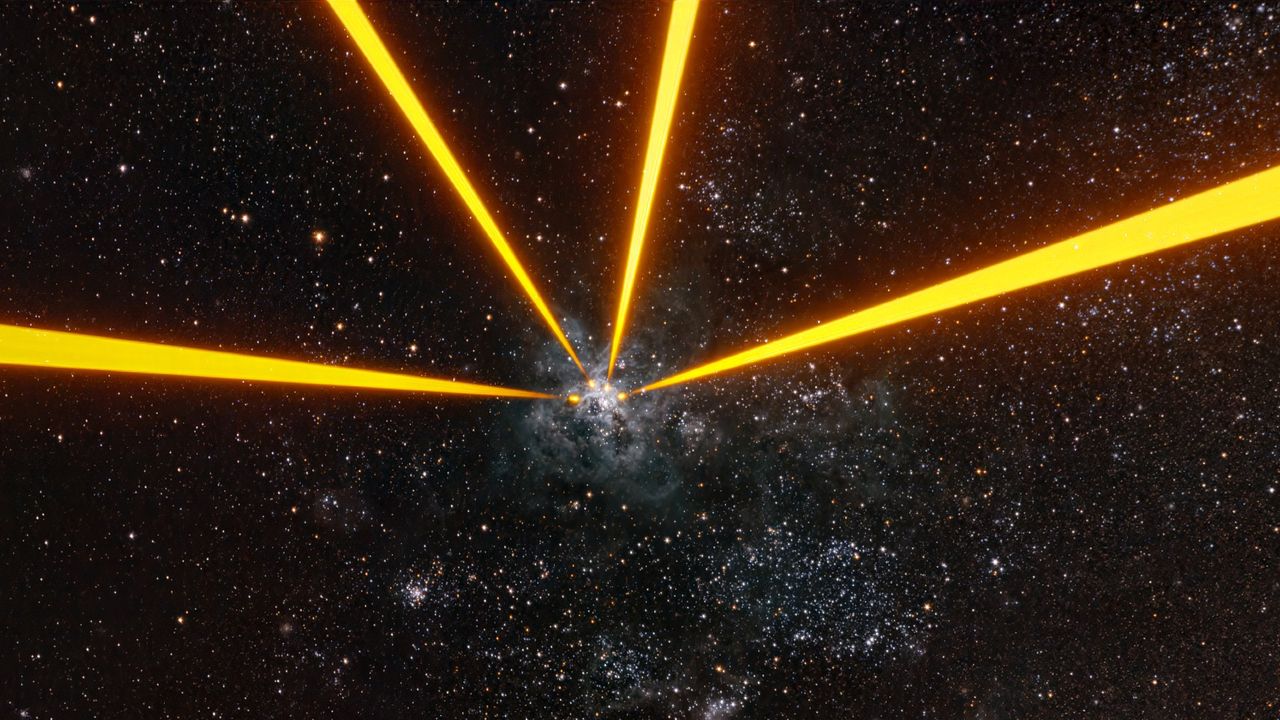
Imagine trying to read a newspaper through a rippling pool of water. That's essentially what ground-based astronomers face every night—the Earth's atmosphere distorts starlight, blurring images and limiting our ability to study the universe. To counter this, observatories employ artificial stars made of laser light. A stunning example comes from the European Southern Observatory's Very Large Telescope Interferometer (VLTI), which recently beamed four powerful laser beams into the sky toward the Tarantula Nebula, a star-forming region in the Large Magellanic Cloud. This guide explains the technology behind such images and walks you through the principles of laser guide star adaptive optics and interferometry, from the basics to advanced implementation.
Prerequisites
Before diving into the step-by-step process, you'll need a foundational understanding of a few concepts. No formal engineering degree required—just curiosity about how telescopes work.
- Basic astronomy: Know what a nebula, galaxy, and star are, and understand that Earth's atmosphere blurs light.
- Physics fundamentals: Familiarity with light as a wave, refraction, and the concept of phase. A high school physics level suffices.
- Computer literacy: While no programming is necessary, an appreciation for real-time control systems helps.
- Optional equipment: If you're a hobbyist astronomer, access to a small telescope or astrophotography setup can help you relate to the challenges.
Step-by-Step Instructions
Step 1: Understand the Atmosphere Problem
Light from distant stars travels millions of light-years in a straight line, but as it enters our turbulent atmosphere, pockets of different temperatures and densities cause the light to refract in unpredictable ways. This creates the twinkling we see with the naked eye and the blurry images astronomers hate. The seeing (a measure of atmospheric steadiness) at a mountaintop site like Cerro Paranal in Chile can be as good as 0.5 arcseconds, but for sharp details, scientists need sub-arcsecond resolution—especially when studying objects like the Tarantula Nebula, which spans several arcminutes across but contains fine details like young star clusters and gas filaments.
Step 2: Introduce Adaptive Optics
Adaptive optics (AO) systems counteract atmospheric distortion in real time. A flexible mirror—usually a thin membrane with hundreds of actuators—deforms its surface thousands of times per second to cancel out the wavefront errors. But the AO system needs a reference star to measure the distortion. If the science target is faint or doesn't have a bright star nearby, nature doesn't cooperate. That's where laser guide stars come in.
Step 3: Create an Artificial Star with a Laser
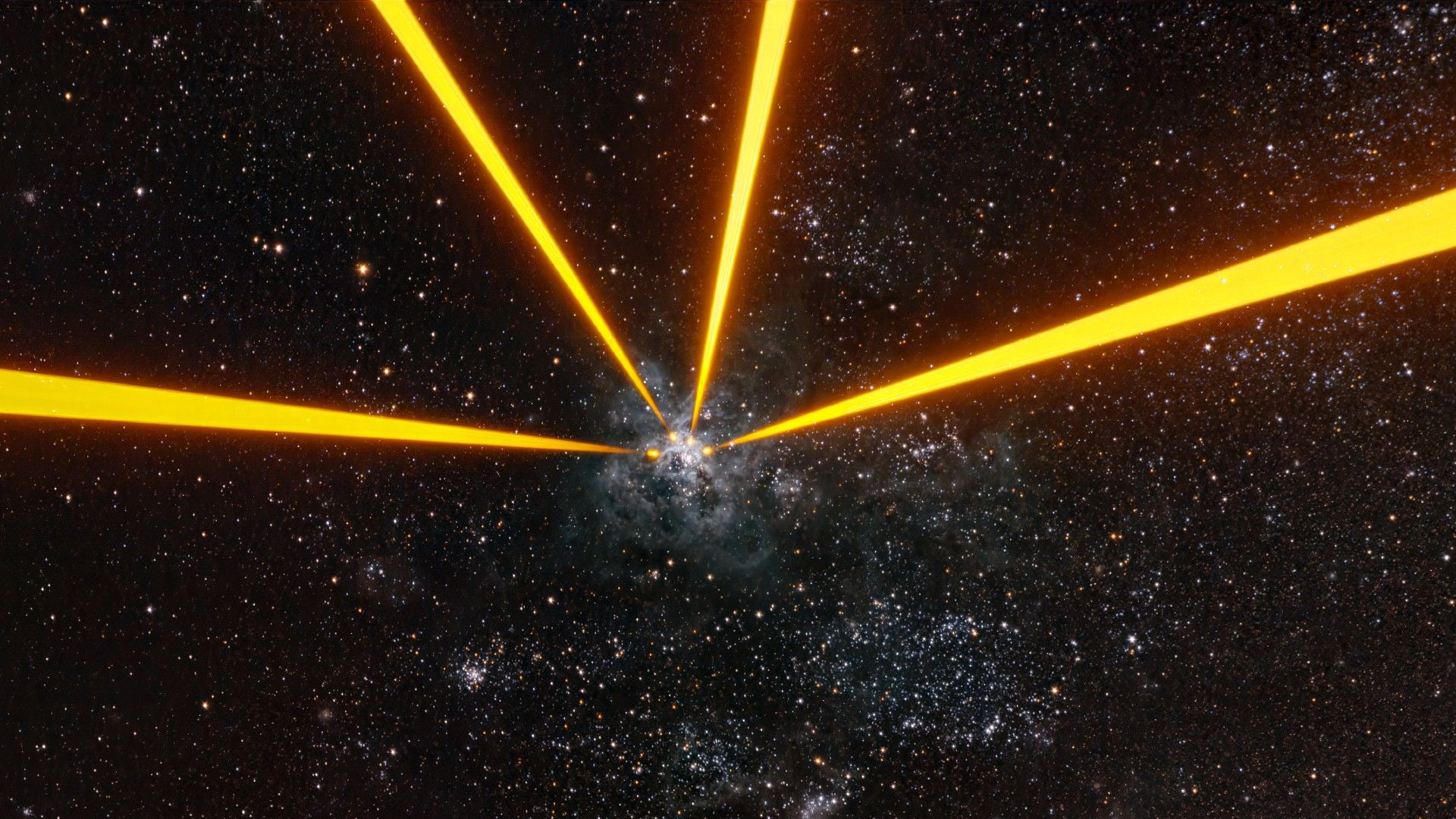
Observatories like the VLTI use powerful lasers tuned to the 589-nanometer wavelength of sodium. They fire the beam into the mesosphere, about 90 kilometers up, where a layer of naturally occurring sodium atoms exists. The laser excites these atoms, causing them to fluoresce—like a glowing, artificial star. In the VLTI's case, four separate lasers are used, one for each of the four Unit Telescopes (or for auxiliary telescopes when working in interferometric mode). The image you may have seen—a scene reminiscent of Star Wars lightsabers—shows these four beams converging on the Tarantula Nebula. Each laser creates a guide star that the AO system can lock onto, measuring the atmospheric distortion along that line of sight.
Step 4: Use the Laser Guide Stars for Wavefront Sensing
Once the artificial star is glowing in the sky, a wavefront sensor (like a Shack-Hartmann sensor) analyzes how the laser light has been distorted by the atmosphere. The sensor divides the incoming light into an array of tiny lenslets, each forming an image of the guide star. By comparing the positions of these spots to their ideal positions, a computer calculates the shape of the distorted wavefront. This data is sent to the deformable mirror, which instantly changes shape to flatten the wavefront. The correction happens at hundreds to thousands of cycles per second.
Step 5: Combine Multiple Telescopes with Interferometry
The VLTI goes a step beyond a single telescope. It combines the light from two or more of the 8.2-meter Unit Telescopes (or the 1.8-meter auxiliary telescopes) to simulate a much larger telescope—as large as the distance between them (up to 130 meters). This technique, called interferometry, requires extremely precise alignment. The laser guide stars help here too: by providing a common reference, the system can correct for atmospheric disturbances at each telescope individually before combining the beams. The result is angular resolution equivalent to a telescope with a diameter of the baseline, allowing scientists to resolve details in the Tarantula Nebula that are otherwise impossible to see, such as the structures around the massive star cluster R136.
Step 6: Observe the Tarantula Nebula
The Tarantula Nebula (30 Doradus) in the Large Magellanic Cloud is a prime target for this technology. It's the most active star-forming region in the Local Group, home to some of the most massive known stars. Using the VLTI with laser guide star adaptive optics, astronomers can study binary star systems, measure stellar diameters, and even probe the dynamics of gas and dust. The familiar image of four lasers piercing the sky toward it is not just a pretty picture—it's a snapshot of engineering in action, with each laser helping to deliver crisp data that would otherwise be lost to atmospheric blur.
Common Mistakes
Even with advanced systems, things can go wrong. Here are pitfalls to avoid when designing or operating laser guide star AO systems.
- Ignoring sky brightness: The sodium laser must be bright enough to create a usable guide star, but not so bright that it scatters into the science camera or affects other observations. Operators must carefully manage laser power and use narrow filters.
- Laser safety oversights: Lasers can interfere with airplanes and satellites. Observatories have laser-spotting cameras and shutters that kill the beam if an aircraft enters the protected zone. Neglecting these protocols can cause safety incidents or costly interruptions.
- Poor tip-tilt correction: While the laser guide star measures high-order aberrations, it cannot sense the overall tilt (the apparent motion of the star) because the laser beam itself is launched from the telescope and experiences the same overall tilt. A separate natural guide star is needed for tip-tilt correction—if that reference is too faint, the system fails.
- Failing to account for cone effect: The laser guide star is at a finite height (90 km), while the science target is at infinity. This means the atmospheric column sampled by the laser is a cone rather than a cylinder, introducing errors for off-axis targets. Newer systems use multiple lasers to overcome this.
- Assuming all wavelengths correct the same: Atmospheric dispersion is wavelength-dependent. The laser is at 589 nm, but science observations may be in infrared or other bands. Correcting for dispersion across the science wavelength range is essential and often requires separate optics.
Summary
Laser guide star adaptive optics, as demonstrated by the VLTI beaming four lasers at the Tarantula Nebula, is a cornerstone of modern ground-based astronomy. By creating artificial stars high in the atmosphere, astronomers can measure and correct for turbulence in real time, achieving images that rival or exceed the clarity of space telescopes. The process involves launching a sodium laser, sensing the wavefront, deforming a mirror, and—when combined with interferometry—synthesizing a giant telescope. This technology has unlocked unprecedented views of the cosmos, from the birthplaces of stars to the hearts of distant galaxies. While complex, understanding its principles empowers both scientists and enthusiasts to appreciate the engineering marvel that makes such observations of the Tarantula Nebula possible.
Related Articles
- NASA Declares Artemis II a Triumph, Moon Landing Next as Systems Prove 'Ready'
- 10 Shocking Facts About Airport Carbon Emissions That Will Change How You Fly
- Cambrian Fossil Discoveries Illuminate the Dawn of Animal Evolution
- 10 Stunning Satellite Views of SpaceX's Falcon Heavy Comeback Launch
- Beyond the Silence: A Comprehensive Guide to the Fermi Paradox and the Great Filter
- Speeding Up Nonlinear Optics Simulations with AI: A Q&A
- Breaking the Memory Barrier: How SSMs Revolutionize Long-Term Video Understanding
- How the 'Feel-Good' Chemical Serotonin Might Fuel Your Tinnitus: A Step-by-Step Guide to Understanding the Latest Research