Apple’s most affordable desktop computer—the M4 Mac Mini with 16GB RAM and 256GB storage priced at $599—has been discontinued worldwide. The move signals a major shift in Apple’s strategy, driven by the explosive growth of AI data centers. Here’s what you need to know about why this cheap Mac Min vanished and how AI changed the game.
1. The End of the Bargain Mac
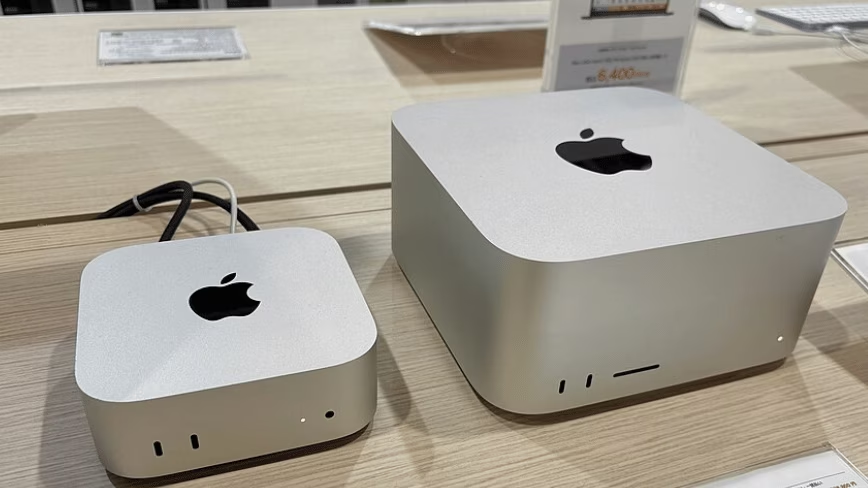
For years, the $599 Mac Mini was the gateway for budget-conscious consumers and developers. With its removal, Apple’s desktop lineup loses its lowest price point. The new entry-level model now starts at $799 with 512GB storage—a 33% increase. This isn’t a simple refresh; it’s a deliberate pivot away from the low-end market. AI’s hunger for memory and processing power made the 256GB configuration obsolete, forcing Apple to reallocate components to more profitable segments.
2. The 256GB Config Fades Away
The 256GB variant was a victim of AI data centers’ insatiable demand for NAND flash memory and high-bandwidth chips. As cloud providers like AWS and Google scale up AI training clusters, they consume the same SSDs Apple used in entry-level Macs. The supply chain simply can’t justify producing low-capacity drives when enterprise orders command premium prices. Apple’s decision to kill the 256GB model reflects a market where storage capacity is now a strategic asset, not just a product spec.
3. AI’s Insatiable Demand for Memory
AI data centers require massive amounts of DRAM and flash storage to handle model training and inference. This has driven up the cost of memory chips globally. Apple’s 256GB Mac Mini used slower, lower-density NAND that is increasingly uneconomical to produce. By discontinuing it, Apple aligns its supply chain with AI-driven demand—opting for higher-capacity drives (512GB or more) that also sell to data centers. The $599 Mac Mini simply couldn’t compete for memory allocation.
4. The M4 Mac Mini’s New Floor
The M4 chip is powerful, but its entry-level configuration now starts at $799 with 512GB storage. This effectively raises the minimum investment for anyone wanting a Mac desktop. The move keeps Apple competitive in higher-margin segments while reducing support costs. It also positions the Mac Mini as a more serious machine—better suited for AI workloads, content creation, and even light server use. The cheap 256GB version didn’t fit that narrative.
5. Storage Supply Chain Shifts
Global NAND flash production is increasingly tailored to AI data center needs. Capacities like 1TB or larger are prioritized, while smaller 128GB and 256GB drives become scarce. Apple, as a major buyer, must negotiate allocations. By standardizing on 512GB, Apple simplifies its inventory and ensures better availability—even if it costs consumers more. This shift is a direct consequence of data center demand for high-capacity SSDs.
6. From Consumer to Compute
The Mac Mini was once a budget-consumer device. Now, Apple markets it as a compact powerhouse for professionals and developers—especially those working with AI models. The $599 version was too limited for modern AI tasks (16GB RAM and 256GB storage bottlenecked performance). By removing it, Apple encourages buyers to invest in configurations that can actually run machine learning frameworks effectively.

7. The Cloud’s Influence on Desktop Pricing
Cloud providers are snapping up premium components, causing price inflation in consumer electronics. Apple can’t compete on price when data centers pay a premium for the same silicon and memory. The $599 price point was unsustainable because the bill of materials—driven by AI demand—had crept up. Apple chose to drop the low-end SKU rather than compromise on margins or performance.
8. What This Means for Budget Buyers
If you were eyeing the $599 Mac Mini, you’re now pushed toward the $799 model or the refurbished market. Budget buyers may consider older Intel Mac Minis or alternative platforms like Windows PCs. Apple’s ecosystem becomes pricier—a trend accelerated by AI component consumption. The death of the 256GB Mac Mini is a clear signal that “affordable Apple” is shrinking.
9. Apple’s Strategic Pivot
Apple is doubling down on high-end hardware: M4 Pro Mac Minis, Mac Studio, and Mac Pro. The company sees a future where desktop Macs are tools for creators and AI developers, not entry-level machines for casual use. This aligns with Tim Cook’s focus on services and premium hardware margins. The $599 Mac Mini was a relic of a less AI-driven era.
10. The Future of Affordable Macs
Don’t expect another cheap Mac Mini anytime soon. Apple may introduce a new low-cost desktop via the Mac Studio lineup or even a redesigned Mac Mini with different pricing tiers. However, until the demand for memory from AI data centers stabilizes, budget-friendly options will remain scarce. For now, the $599 Mac Mini is buried under the weight of AI’s insatiable appetite for silicon.
Conclusion: The passing of the $599 Mac Mini is a clear sign that AI data centers are reshaping consumer electronics—not just performance, but pricing and availability. Apple’s shift to a $799 base model reflects new market realities where memory and storage are precious resources. Budget buyers lose, but the industry gains faster innovation. The $599 Mac Mini is dead—long live the AI-driven future.