The Y-Zipper: A 3D-Printed Mechanism for Rapid, Reversible Assembly of Flexible-to-Rigid Structures
Introduction: Zipping from Flat to Functional
Zippers are ubiquitous fasteners, found on everything from jackets to luggage. They offer a quick, reliable way to join two pieces of fabric—and, as innovators have discovered, they can do much more. Researchers led by Jiaji Li have developed the Y-zipper, a 3D-printable mechanism that transforms flexible 2D strips into rigid 3D forms. This concept opens up possibilities for temporary structures, pop-up assemblies, and dynamic shape-changing objects. Unlike conventional zippers, the Y-zipper is designed from the ground up for additive manufacturing, enabling curved geometries, automatic actuation, and seamless integration with other components.
How the Y-Zipper Works
Basic Mechanics
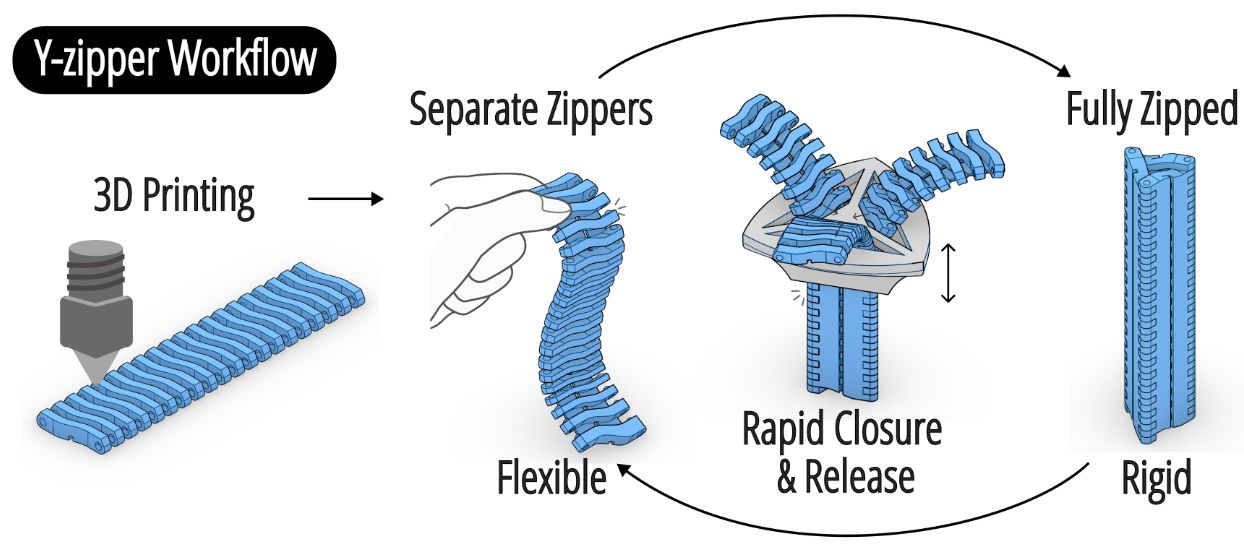
The Y-zipper follows the fundamental principle of interlocking teeth that a slider alternately pushes together or pulls apart. However, its design deviates from the standard straight strip. By curving the teeth and the supporting base, the zipped-up form can adopt distinct bends, coils, or even screw-like shapes. This flexibility-to-rigidity transition occurs in seconds, making it ideal for applications that require rapid assembly and disassembly.
Comparison with Existing Mechanisms
While other shape-locking techniques exist—such as snap-fit joints, origami-inspired folds, or magnetic connectors—the Y-zipper combines the ease of a regular zipper with the ability to create curved geometry and automatic actuation. It also offers a high degree of reversibility; unzipping returns the structure to its flat, flexible state. This sets it apart from permanent joining methods.
Design and Material Considerations
3D Printing with PLA and TPU
The Y-zipper is designed for fused deposition modeling (FDM) 3D printing using common materials. PLA (polylactic acid) provides stiffness for the main body, while TPU (thermoplastic polyurethane) is used for compliant bridges that allow smooth movement and flexibility. The researchers demonstrated that these materials can produce functional zippers up to about 3 meters in length before structural disintegration becomes an issue. Longer lengths would require reinforcement or alternative materials.
Curved Geometry and Self-Actuation
One of the key innovations is the ability to print curved zipper strips that, when zipped, form predetermined 3D shapes. The slider can be manually operated or, in advanced versions, automatically actuated by a small motor or spring. This opens up possibilities for self-deploying structures, such as antennas, temporary shelters, or robotic components.
Demonstrated Applications
Tent Poles and Pop-Up Supports
A natural application is in pop-up tents. Multiple Y-zipper rods can be joined using a specially designed joint mechanism, forming a sturdy, lightweight frame that can be assembled and disassembled in seconds. This could replace traditional tent poles, offering easier packing and faster setup.
Integration with Fabric
The researchers also showed that fabric can be directly integrated into the Y-zipper structure. By embedding textile pieces into the printed parts, the mechanism becomes part of a larger composite system—useful for clothing, bags, or deployable shelters where both rigidity and flexibility are needed at different times.

Compliant Bridges and Continuous Forms
Using TPU for small bridges between teeth allows the zipper to bend and flex without breaking. This enables the creation of coiled or helical shapes that remain rigid when zipped but collapse when unzipped. Such forms could be used in robotics as gripping tools or in packaging as reusable containers.
Limitations and Future Directions
Maximum Length and Material Constraints
Currently, the maximum functional length is around 3 meters due to the inherent weakness of thin printed teeth. For larger structures, either stronger materials (e.g., nylon composites) or hybrid manufacturing (e.g., combining 3D-printed parts with metal inserts) would be needed. The researchers note that optimizing tooth geometry and slider design could push these limits further.
Scalability and Manufacturing
While 3D printing offers design freedom, it is slower than mass-production techniques. For commercial viability, injection molding or continuous extrusion of Y-zipper profiles might be developed. The open-source nature of the design, however, allows enthusiasts and small businesses to experiment with custom shapes and applications.
Potential Beyond Tents
Beyond camping gear, the Y-zipper could find use in emergency shelters, temporary signage, deployable solar panels, or even architectural installations that change shape. The concept also aligns with the growing field of 4D printing, where materials or structures respond to stimuli over time.
Conclusion: A New Fastener for a Flexible World
The Y-zipper elegantly extends the humble zipper into a domain of shape-changing engineering. By combining 3D printing, smart geometry, and reversible assembly, it offers a practical method for creating rigid 3D structures from flat, flexible strips. While not without limitations, the technology demonstrates how familiar mechanisms can be reimagined for modern manufacturing and design. As research continues, we may soon see Y-zippers in everyday products—from pop-up tents to dynamic furniture.
Learn more about related mechanisms in our article on Origami-Inspired Structural Engineering and 3D Printing with Flexible Materials.
Related Articles
- Protecting Your ASP.NET Core Applications: Applying the .NET 10.0.7 Out-of-Band Security Patch
- Instructure Data Breach Report: Lessons in Journalistic Verification
- How Fraudsters 'Borrow' from Credit Unions: A Step-by-Step Breakdown
- Browser-Based Data Exfiltration Exposes Critical DLP Blind Spot
- Meta's Latest Enhancements for End-to-End Encrypted Backups: A Q&A Guide
- 6 Startling Revelations About the Anti-DDoS Firm That Launched Attacks on Brazilian ISPs
- DarkSword iOS Exploit Unleashed: Six Zero-Day Vulnerabilities Weaponized by State Actors
- Critical CPanel & WHM Authentication Bypass Flaw Exploited in Wild – Urgent Patch Required