5 Crucial Facts About NASA's SpaceX 34th Resupply Mission
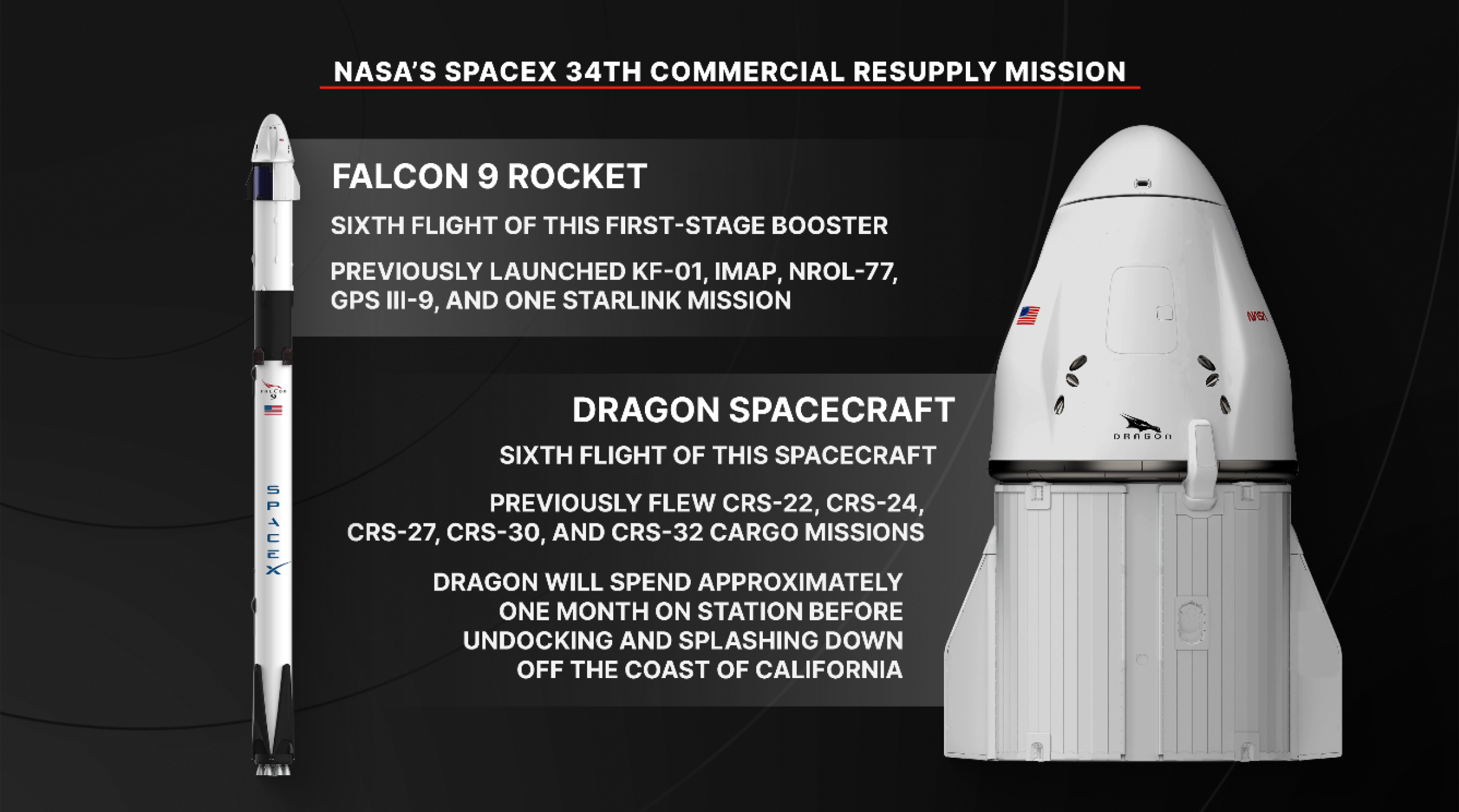
Get ready for another milestone in space exploration as NASA and SpaceX prepare to launch their 34th commercial resupply mission to the International Space Station. This mission, carrying over 6,500 pounds of vital cargo, will lift off from Florida's Cape Canaveral Space Force Station in mid-May aboard a Falcon 9 rocket. The Dragon spacecraft will autonomously dock with the station's Harmony module, delivering supplies and cutting-edge scientific experiments. Here are five key things you need to know about this exciting voyage.
1. Launch and Docking Details
The mission will launch from Launch Complex 40 at Cape Canaveral Space Force Station in Florida, using SpaceX's reliable Falcon 9 rocket. The Dragon spacecraft is packed with approximately 6,500 pounds of supplies, including food, equipment, and science payloads for the crew aboard the ISS. After liftoff, Dragon will autonomously navigate to the space station and dock at the forward port of the Harmony module. This precise docking demonstrates the continued success of commercial partnerships in space. Coverage of both launch and arrival will be available on NASA+, Amazon Prime, and NASA's YouTube channel, so you won't miss a moment of the action.
2. Supporting Over Two Decades of ISS Research
For more than 25 years, the International Space Station has been a hub for scientific discovery. Scientists from over 110 countries have conducted more than 4,000 experiments in the unique microgravity environment. Research on the ISS not only benefits life on Earth but also paves the way for future deep-space missions, including NASA's Artemis program aimed at returning humans to the Moon and eventual journeys to Mars. The 34th resupply mission continues this legacy by delivering tools and experiments that will help solve challenges in long-duration spaceflight, such as radiation exposure and resource sustainability.
3. ODYSSEY: Testing Microgravity Simulators on Earth
One of the fascinating experiments aboard Dragon is ODYSSEY. This study will examine how bacteria behave in actual microgravity compared to Earth-based simulators that mimic weightlessness. Researchers will grow bacterial cultures on the ISS and then compare the results with identical cultures grown in microgravity simulators on the ground. The goal is to determine how accurately ground-based simulators can recreate the space environment. This knowledge is crucial for planning future experiments and ensuring that pre-flight tests are reliable. Understanding bacterial behavior in space also has implications for astronaut health and spacecraft hygiene.
4. STORIE: Monitoring Space Weather's Charged Particles
STORIE is an instrument designed to monitor charged particles orbiting Earth. These particles are influenced by space weather events like solar flares and geomagnetic storms, which can disrupt power grids, satellites, and communication systems. By continuously measuring the flux and energy of these particles from the ISS, researchers hope to gain better insight into how space weather changes. The data could improve prediction models, allowing us to protect critical infrastructure on Earth and in orbit. This experiment underscores the ISS's role as a platform for real-time environmental monitoring.
5. Laplace: Unraveling the Secrets of Dust in Space
The Laplace experiment investigates the movement and collisions of dust particles in microgravity. Dust plays a key role in planetary formation—understanding how particles stick together and grow in space can reveal how our solar system's planets, including Earth, came to be. In microgravity, dust behaves differently than on Earth, and Laplace will track individual particles to study their motions. This fundamental research could also shed light on processes in other planetary systems. The findings from Laplace will help scientists piece together the early history of our cosmic neighborhood.
In summary, NASA's SpaceX 34th commercial resupply mission is more than just a delivery run—it's a vital step in advancing science and exploration. From testing microgravity simulators to monitoring space weather and understanding planet formation, each experiment brings us closer to a future where humanity thrives in space. Stay tuned for the launch and watch history unfold.
Related Articles
- Exploring Astronauts for America: A New Era of Space Advocacy
- Rocket Industry Update: Starship, Blue Moon, and the Pentagon's Space Defense Initiative
- Decoding Cephalopod Evolution: A Genomic Journey Through Mass Extinctions
- The Exodus of Educators: Unpacking the Crisis in Teacher Retention
- Blood Test May Predict Depression Before Symptoms Emerge, Scientists Say
- How to Engineer a Memory Chip That Defies Miniaturization Limits
- Unboxing the Ultimate Lego Star Wars Yoda Bust: Questions and Answers
- Empowering Educators: How NASA eClips and GLOBE Cultivate a Coastal Virginia STEM Ecosystem