How to Shield Your Software Supply Chain from Watering Hole Attacks with AI-Powered EDR
Introduction
In April 2026, cybercriminals compromised the official CPUID domain at the API level, turning a trusted software download into a silent malware delivery system. For 19 hours, users who visited cpuid.com received a legitimate‑looking CPU‑Z installer bundled with a malicious payload. The attack exploited a fundamental vulnerability: the trust chain broke above the end user. No amount of user caution could prevent it. Read on for a step‑by‑step guide to defending your organisation against similar supply‑chain infiltration using adaptive AI Endpoint Detection and Response (EDR).

What You Need
- AI‑powered EDR solution – e.g., SentinelOne with autonomous behavioral detection.
- Centralised security console for real‑time alerts and investigation.
- Threat intelligence feed covering supply‑chain attack patterns.
- Incident response playbook with predefined automation rules.
- Endpoint agents deployed on all systems that download or execute third‑party software.
Step‑by‑Step Guide
Step 1: Monitor for Anomalous Process Chains
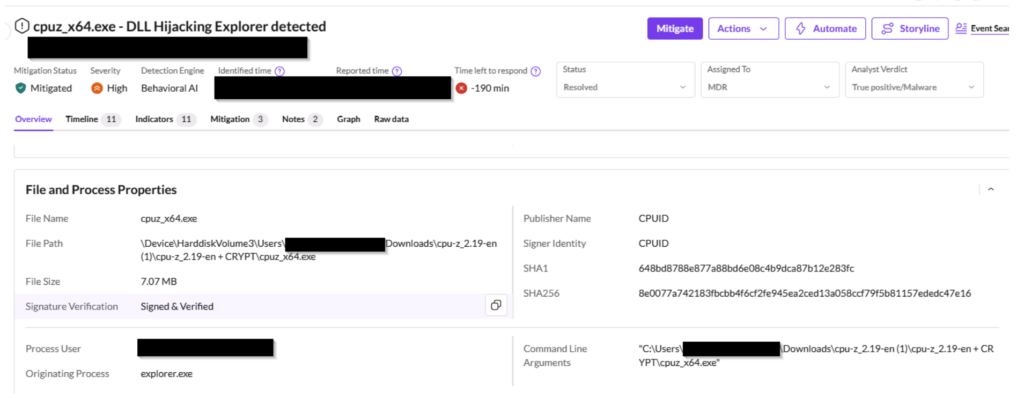
During the CPU‑Z attack, the malicious binary (cpuz_x64.exe) was correctly signed and came from the vendor’s own infrastructure. The red flag was its process chain: it spawned PowerShell, then csc.exe (C# compiler), then cvtres.exe (resource compiler). CPU‑Z never does that. Configure your EDR to baseline normal process behaviour for each application and alert on any deviation. For example, a system monitoring tool should never invoke compilers or script interpreters. Use behavioral whitelisting for known good chains and raise alerts for unexpected parent‑child relationships.
Step 2: Detect Five Critical Behavioral Indicators
The SentinelOne agent triggered "Penetration framework or shellcode was detected" within seconds because five indicators converged. Make sure your EDR tracks these:
- Anomalous API resolution – the process locates system functions via non‑standard methods, bypassing the OS loader. Monitor calls to GetProcAddress with unusual flags or direct memory scanning.
- Reflective code loading – executable code runs from memory regions without a matching file on disk. Enable memory scanning for injected code.
- Suspicious memory allocation – requests for Read‑Write‑Execute (RWX) permissions are a classic staging pattern. Alert on any RWX allocation by non‑critical processes.
- Process injection patterns – execution flow consistent with code being redirected into a secondary process (e.g., via CreateRemoteThread). Log all cross‑process write operations.
- Heuristic shellcode signatures – sequential operations typical of exploitation toolkits preparing an environment. Use AI models that recognise these opcode sequences.
Step 3: Automate Autonomous Response
When the five indicators aligned, SentinelOne’s AI autonomously terminated and quarantined the involved processes before the attack advanced. Set your EDR to automatically respond to high‑confidence behavioral alerts – kill the malicious process, isolate the endpoint, and block further executions of the same binary. Do not rely solely on manual analysis; speed is critical in supply‑chain attacks where the payload can spread laterally within minutes.
Step 4: Look Beyond Digital Signatures
The CPU‑Z binary had a valid digital signature from the vendor. Attackers had compromised the API to redirect downloads to their own servers, yet the signature remained genuine because the file was still signed by CPUID. Trust but verify behavior – signatures confirm identity, not intent. Implement a policy that any binary triggering behavioral alerts is treated as suspicious regardless of its signature. Override trust only after manual review of the entire process chain.
Step 5: Correlate with Threat Intelligence
SentinelOne’s Annual Threat Report identifies this pattern as a systemic shift – compromised developer accounts becoming attack vectors. The GhostAction campaign (late 2025) saw a GitHub maintainer account push malicious workflows; an NPM maintainer phishing attack led to cryptocurrency‑intercepting code. Both appeared legitimate because commit logs came from valid accounts. Integrate your EDR with threat intelligence feeds that highlight such supply‑chain campaigns. When a new indicator of compromise (IoC) appears (e.g., a known malicious DLL like CRYPTBASE.dll placed in the app folder), automatically block it across all endpoints.
Step 6: Educate Users and Update Trust Models
The CPU‑Z victims did everything right – they visited the official site and clicked the official download button. The trust chain broke above them. Train users to report any unusual system behavior (e.g., unexpected pop‑ups, slow performance) after installing legitimate software. More importantly, update your organisation’s trust model: no software is inherently safe solely because of its origin. Implement application‑control policies that restrict execution to approved publishers and require behavioral validation. Regular audits of third‑party software usage can reduce exposure.
Tips for Long‑Term Defence
- Focus on behaviour, not signatures. Signature‑based detection would have missed the CPU‑Z attack because the binary was legitimately signed. Behavioral analysis catches zero‑day payloads.
- Tune alerting for false positives. Some legitimate applications (e.g., software installers) do spawn PowerShell. Use baselines and allow‑listing for known benign chains.
- Conduct regular incident‑response drills. Simulate a watering hole attack where a trusted download triggers anomalous process chains. Test autonomous response times and manual escalation paths.
- Monitor for hidden DLLs. In this attack, a malicious CRYPTBASE.dll was placed alongside the legitimate cpuz_x64.exe. Enable file‑integrity monitoring for system and application directories.
- Keep EDR rules updated. Threat actors evolve – ensure your AI models receive regular updates from security vendors. Subscribe to vendor threat briefings.
- Harden the supply chain. Require vendors to adopt secure software distribution practices (e.g., code signing with hardware security modules, multi‑factor authentication for build pipelines). Consider a software bill of materials (SBOM) for critical applications.
By implementing these steps, you can build a defence that protects against supply‑chain attacks like the CPU‑Z watering hole – attacks that exploit trust rather than technical vulnerabilities. Remember: the next attack will work the same way. Your EDR must see beyond the signature and act autonomously when the behaviour doesn’t match.
Related Articles
- How to Avoid Becoming a Cybersecurity Professional Convicted in Ransomware Attacks: Lessons from the BlackCat Case
- Vacuum Tubes' Final Frontier: Breakthroughs That Defied the Transistor Revolution
- 10 Critical Strategies to Prevent a Single Click from Wrecking Your Network: The Patient Zero Playbook
- 10 Key Insights Into Self-Syncing Festival Badges
- Scattered Spider Leader 'Tylerb' Pleads Guilty in $8 Million Crypto Phishing Scheme
- Securing Linux Against Copy Fail: A Step-by-Step Mitigation Guide
- AI-Powered Bug Hunt Uncovers 271 Zero-Day Vulnerabilities in Firefox — A Record Security Patch
- Claw Chain Uncovered: 4 OpenClaw Vulnerabilities Enabling Full System Compromise