5 Key Things to Know About Go 1.26's Source-Level Inliner
The release of Go 1.26 brings a completely rethought go fix command, now designed to help developers keep their codebases modern with minimal effort. Among its new features, the source-level inliner stands out as a versatile tool for automated refactoring. It allows package authors to define simple API migrations and upgrades that users can apply with a single command. In this article, we explore five critical insights into how the source-level inliner works, why it matters, and how you can leverage it to simplify your Go development workflow.
- 1. What Is Source-Level Inlining?
- 2. How It Differs from Compiler Inlining
- 3. The Role in gopls Refactoring
- 4. Self-Service API Migrations with
go fix - 5. Technical Underpinnings and Correctness
1. What Is Source-Level Inlining?
The source-level inliner is a transformation algorithm that replaces a function call with a copy of the called function's body, substituting actual arguments for formal parameters directly in the source code. This is fundamentally different from the inlining done by compilers, which operates on an intermediate representation and focuses on performance optimization. Here, the goal is durable source modification—the code is changed permanently, making the transformation visible and editable by developers. This capability was originally built for the gopls language server and is now integrated into the new go fix command, enabling self-service API migrations. For example, you can invoke gopls’ “Inline call” action to see the before‑and‑effect: the call to sum in a function six is replaced by the arithmetic expression 1 + 2 + 3.

2. How It Differs from Compiler Inlining
Compiler inlining is an optimization technique applied to ephemeral representations; it never alters the original source files. In contrast, the source-level inliner makes permanent, file‑level changes. This difference is crucial for developer tooling. When you run go fix, you want the source code to be updated so that you can review, commit, and share the changes. Compiler inlining, on the other hand, is invisible to the programmer. The source-level inliner handles many of the same correctness challenges—like preserving variable scoping, handling side effects in arguments, and managing multiple return values—but it does so in a way that results in legal, human‑readable Go code. This makes it an ideal building block for refactoring operations that must be safe and transparent.
3. The Role in gopls Refactoring
Before its inclusion in go fix, the source-level inliner was already powering several gopls refactoring commands. The most direct is “Inline call,” but it also serves as the engine behind “Change signature” and “Remove unused parameter.” When you change a function’s signature, gopls must update all call sites; the inliner helps by evaluating whether a parameter can be removed safely and propagating the changes. The algorithm carefully handles subtle issues such as variable shadowing, order of evaluation, and interactions with closures. For instance, if a parameter is used only to provide a default value, the inliner can replace the function call with its body after inlining the default, effectively simplifying the code. This ensures that refactored code remains correct and idiomatic.
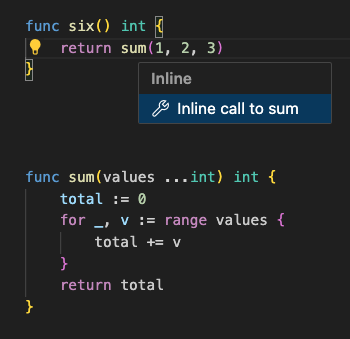
4. Self-Service API Migrations with go fix
The real breakthrough is that the source-level inliner now enables self-service API migrations. Package authors can annotate their functions with special //go:fix directives, defining how callers should be updated when an API changes. For example, if you rename a function from OldName to NewName, you can write a simple inline rule that tells go fix to replace every call to OldName with NewName, adjusting arguments as needed. Users of the package simply run go fix in their project, and the tool automatically applies all these migrations. This eliminates manual, error‑prone search‑and‑replace tasks and ensures consistency across the ecosystem. It’s a powerful way to evolve APIs without breaking existing code.
5. Technical Underpinnings and Correctness
Building a source-level inliner that is both safe and general is challenging. The Go team’s implementation handles multiple cases that could otherwise produce incorrect code: functions with variadic parameters, functions that return multiple values, and calls where arguments have side effects. It also correctly renames identifiers to avoid conflicts with local variables. The algorithm uses a technique called “hygienic transformation,” borrowed from macro systems, to guarantee that inlined code does not accidentally capture or shadow variables. By integrating this inliner into go fix as a reusable analyzer, the Go team has created a foundation for future automated upgrades. Package authors no longer need to write custom tools—they can express migrations declaratively, and the tool ensures correctness automatically.
The source-level inliner is more than just a neat feature; it represents a shift towards making Go code evolution safer and more accessible. Whether you’re a library author planning an API upgrade or a developer wanting to modernize your codebase, this tool simplifies the process. Go 1.26’s go fix is a must‑try for anyone writing Go.
Related Articles
- How the Python Packaging Council Came to Be: A Step-by-Step Guide
- The Security Dilemma of Autonomous AI Assistants: How OpenClaw Is Redefining Risk
- Pyroscope 2.0: Revolutionizing Continuous Profiling for Modern Observability
- Python 3.15 Alpha 4: A Developer Preview with Performance Boosts and UTF-8 Default
- How the Python Packaging Council Was Formed: A Step-by-Step Guide to Governance
- Microsoft Releases Earliest DOS Source Code to Public on 45th Anniversary
- NVIDIA's Nemotron 3 Nano Omni: A Single Model for Vision, Audio, and Language Boosts AI Agent Efficiency by 9x
- 7 Reasons Dual Parameter Styles in mssql-python Will Revolutionize Your SQL Workflow