Mastering GitHub Copilot CLI: Interactive and Non-Interactive Modes Explained
Overview
GitHub Copilot CLI brings the power of AI-assisted coding directly into your terminal. Whether you're debugging, exploring a new repository, or automating repetitive tasks, Copilot CLI offers two distinct modes to suit your workflow: interactive mode for collaborative, back-and-forth conversations, and non-interactive mode for fast, single-shot queries. This guide will walk you through both modes from the ground up—no prior Copilot experience required. You'll learn how to enter each mode, what they're best for, and see practical examples you can try right away.
Prerequisites
Before diving in, make sure you have the following ready:
- A GitHub Copilot subscription (individual, business, or enterprise) with CLI access enabled.
- The GitHub Copilot CLI tool installed on your local machine. (If you haven't yet, run
npm install -g @githubnext/github-copilot-clior follow the official setup guide.) - Basic familiarity with the command line (navigating directories, running commands).
- A Git repository to experiment with (any local project will do).
Step-by-Step Instructions
Interactive Mode: Chatting Your Way Through
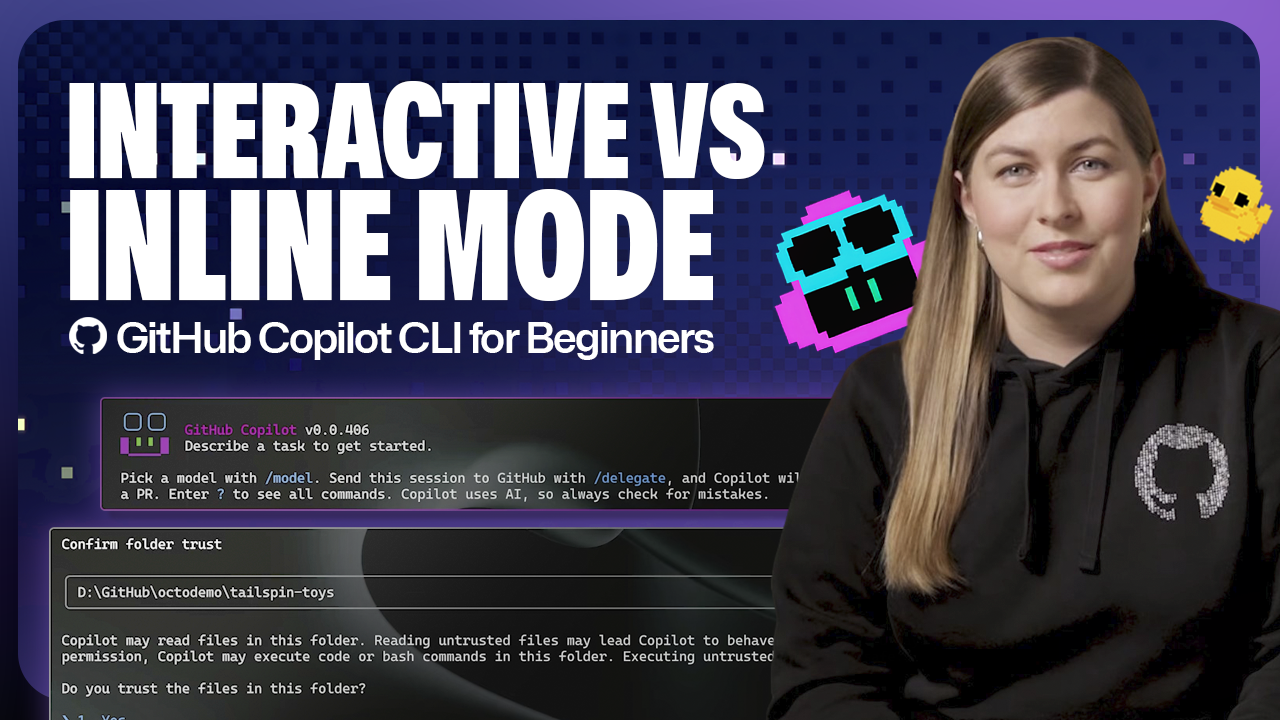
Interactive mode is the default experience when you launch the Copilot CLI. Think of it as having an AI pair programmer sitting beside you, ready to answer questions, run commands, and iterate on solutions in real time.
- Launch interactive mode
Open your terminal and type:
copilot
Press Enter. The first time you run this in a project folder, Copilot may ask for permission to read and modify files. Typeyesto trust the folder. - Start a conversation
Once inside the interactive session, you’ll see a prompt where you can ask questions. For example:
How do I run this project locally?
Copilot will analyze your project structure and provide step-by-step instructions. - Take action collaboratively
After receiving instructions, you can ask Copilot to execute them for you:
Can you run it for me?
Copilot will examine your project’s configuration (e.g.,package.jsonorrequirements.txt) and start the server or build process. - Iterate within the same session
You can continue the conversation with follow-up questions, like “What does the main function do?” or “Add an Express route for /health.” Each prompt stays within the same session, preserving context. - Exit interactive mode
Typeexitor press Ctrl+C to return to your normal terminal prompt.
Example output snippet:
> copilot
🤖 I'm ready! Ask me anything about your project.
> How do I run this project locally?
📘 Based on your package.json, try:
  npm install
  npm start
> Can you run it for me?
✅ Running npm install...
✅ Starting server on port 3000.
Non-Interactive Mode: Quick Answers Without the Chat
Non-interactive mode is designed for speed. Instead of entering a session, you pass a one-off prompt directly on the command line using the -p (or --prompt) flag. Copilot returns the answer and exits immediately—perfect for automation scripts or when you just need a fast fact.
- Ensure you're at the regular shell prompt
If you’re still inside an interactive Copilot session, typeexitfirst. - Construct a non-interactive command
The syntax is:
copilot -p "your prompt here"
For example:
copilot -p "Quickly summarize what this repository does and the key folders." - Get your answer
Copilot will scan the project files and output a concise summary—right in your terminal, then return control to you.
Example output snippet:

$ copilot -p "Summarize this repo"
📝 This is a Node.js web app using Express. Key folders:
- src/ : source code (routes, models)
- public/ : static assets
- tests/ : unit tests
- package.json : dependencies and scripts
You can also use non-interactive mode for code generation, file descriptions, or integrating into CI/CD pipelines. Because it doesn't require a session, it's ideal for automated workflows where you need a quick answer without human interaction.
Common Mistakes
- Forgetting to exit interactive mode before using non-interactive
If you typecopilot -p "..."while inside an interactive session, the command may be interpreted as a prompt within that session rather than a new non-interactive call. Alwaysexitfirst. - Not trusting the folder
When Copilot asks “Do you trust this folder?” and you decline, it won’t be able to read your files. Answeryes(or configure trust globally) to unlock full functionality. - Vague or overly broad prompts
Both modes work best with clear, specific questions. Instead of “Help me,” try “Explain the purpose of thesrc/utils.jsfile.” - Assuming non-interactive mode retains context
Unlike interactive mode, each non-interactive prompt is independent. You cannot follow up without starting a new command—so use interactive mode for multi-step tasks.
Summary
GitHub Copilot CLI offers two complementary modes: interactive for deep, iterative exploration and non-interactive for rapid, one-off queries. Interactive mode shines when you need to discuss, refine, and act on code collaboratively; non-interactive mode excels at quick summarization, code snippets, and script automation. By mastering both, you can navigate your projects with greater efficiency and confidence. Start with a simple experiment—launch interactive mode in a project you know well, then try a non-interactive summary—and see how much faster your terminal workflow becomes.
Related Articles
- HashiCorp Vault Unveils Native AI Agent Security Framework: Ephemeral, Identity-Based Access Controls Address Autonomous System Risks
- How to Migrate Your Photo Collection from OneDrive to Ente Photos: A Step-by-Step Guide
- Meta's Pyrefly Type Checker Now Powers PyCharm's Code Insight at Lightning Speed
- Fonttrio: Streamlining Font Pairing for shadcn/ui with an Open-Source Registry
- Defending Against Supply Chain Attacks: How AI-Powered EDR Neutralized the Axios RAT Campaign
- How to Create Your First AI Agent with the Microsoft Agent Framework
- Finding Lost Files: How Full-Text Search Transformed My Document Retrieval
- Cline Unveils Open-Source SDK: A Modular Agent Runtime Powering Cross-Platform Development